
Search interest around "arxiv bans unchecked AI content" has grown because the policy touches a practical fear: can a researcher lose access to a major preprint platform because of careless AI use? Reporting from Ars Technica, Nature, CASRAI, and university library explainers points to the same basic answer. arXiv is targeting obvious, unverified AI-generated material in submitted manuscripts, not banning every use of writing tools.
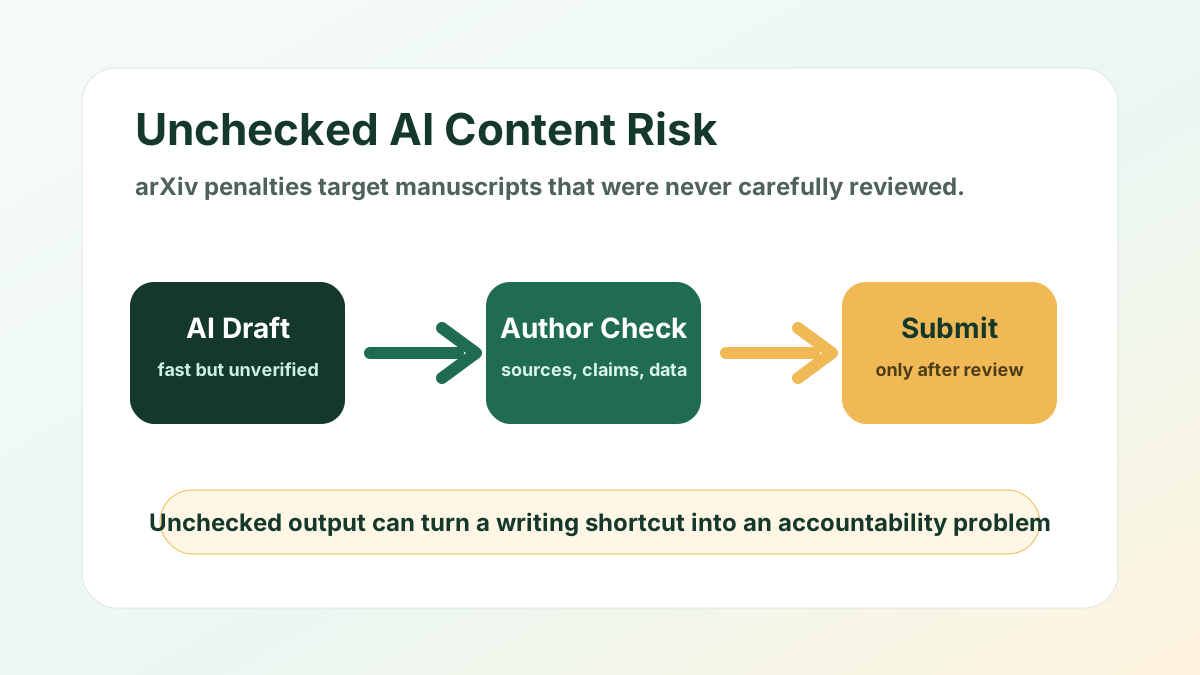
That distinction matters. AI can help with outlining, language polishing, grammar, and readability. It can also invent sources, misread claims, and leave behind text that was never meant to appear in a paper. arXiv's message is that authors remain accountable for the final manuscript. If your name is on the paper, you are responsible for every claim, every table, every figure, and every reference, no matter how the draft was produced.
What did arXiv announce?
Reports in May 2026 described a stronger arXiv penalty for manuscripts with clear evidence of unchecked AI-generated content. The sanction is severe: a one-year submission ban, followed by a requirement that later submissions first be accepted by a reputable peer-reviewed venue before arXiv will host them. This is why the policy drew attention across academic publishing. For fields where arXiv is central to sharing early research, losing submission access can be a serious professional setback.
The policy is best understood as an author-accountability rule. It does not say that all AI-assisted writing is forbidden. It says that if a submission contains incontrovertible evidence that the authors did not check the results of LLM generation, arXiv cannot trust the paper. In other words, the platform is responding to negligence, not to every instance of AI help.
What counts as unchecked AI content?
Unchecked AI content is not simply a sentence that sounds polished or a paragraph that used grammar assistance. The clearest examples are mistakes that strongly suggest the manuscript was copied from AI output without review. The most discussed example is hallucinated references: citations to papers, authors, journals, years, DOIs, or conference proceedings that do not exist. These fake citations can look convincing, but they break the scholarly record because readers cannot verify them.
Other examples include leftover chatbot meta-commentary such as "Here is a 200-word summary" or "Would you like me to make changes?" A paper may also contain placeholder instructions like "fill in the real numbers from your experiment" or "insert citation here." Those are not subtle judgment calls. They are signs that the final manuscript was not read closely before submission.
There are also harder cases. A real paper may be cited for a claim it does not support. A table may contain a number that does not match the methods section. A figure caption may describe a different result than the figure shows. These may not always trigger the same obvious evidence standard, but they still create risk. Responsible authors should treat them as serious pre-submission checks.
Is arXiv banning AI use completely?
No. The safer reading is that arXiv bans unchecked AI content, not all AI assistance. Many researchers use AI tools for copy-editing, translation support, sentence smoothing, or brainstorming. Those uses can be compatible with academic integrity when authors verify the result and follow the relevant disclosure rules for their institution, journal, conference, or repository.
The line is accountability. A human author can consent to publication, answer questions, correct mistakes, and defend the work. An AI tool cannot. That is why authorship rules across publishing generally reject AI as a coauthor while still allowing limited AI assistance. The human author must inspect the text, verify the sources, and approve the final version.
Why hallucinated references are especially risky
References are not decorative. They are the map that lets readers trace the argument. If a paper cites non-existent sources, the damage goes beyond one bad sentence. It can mislead reviewers, waste readers' time, and pollute citation graphs. Even worse, hallucinated references can look plausible because they combine real author names, familiar venues, and scientific-sounding titles.
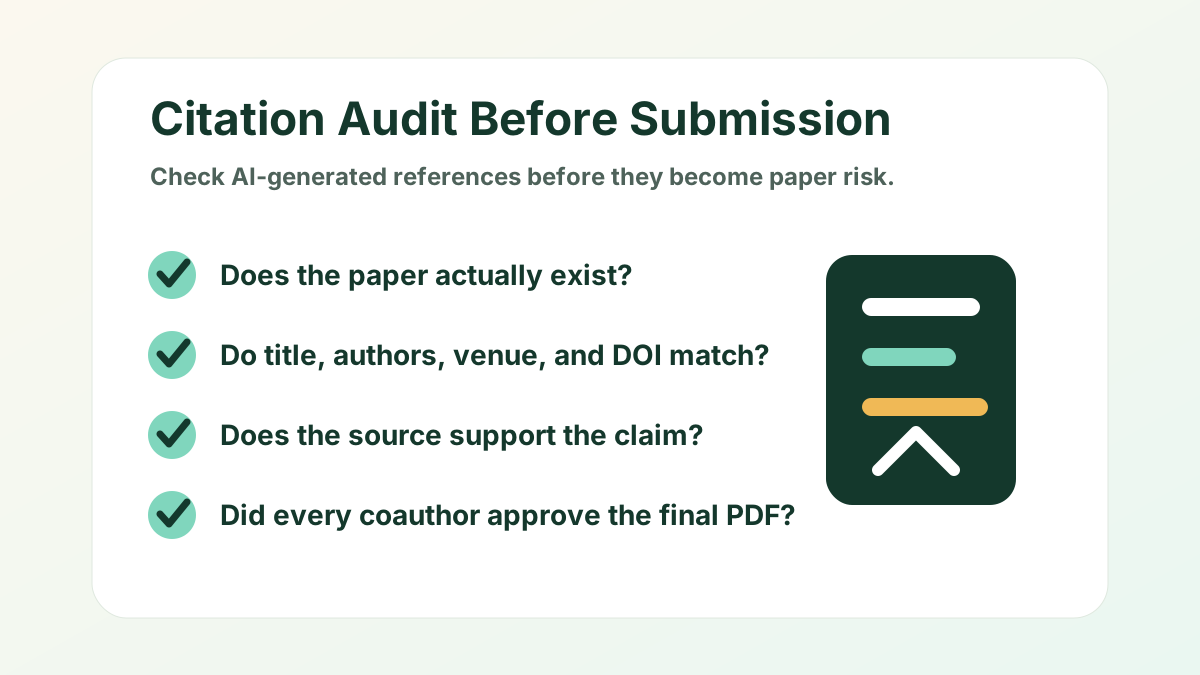
Researchers sometimes assume a citation is safe because an AI tool produced it with confidence. That is a mistake. A language model can generate a realistic bibliography entry without retrieving a real paper. Even when a paper exists, the model may overstate what that paper shows. That is why citation checking has to include both existence and relevance. Does the source exist? Does it actually support the sentence where it is cited?
Will one or two citation errors trigger a ban?
Not every typo or metadata error is the same as unchecked AI content. A wrong page number, a slightly incorrect year, or a formatting mistake can happen in ordinary academic writing. The higher-risk category is clear evidence that a reference was fabricated or that AI output was never verified. Reports describe the evidentiary standard as "incontrovertible," meaning the problem has to be obvious enough to show the authors did not check the AI-generated result.
Still, authors should not treat that distinction casually. A single fake citation can damage trust in the entire manuscript. If a moderator, reviewer, or reader finds one fabricated reference, the natural question is whether the rest of the paper was checked with the same care. The best strategy is not to guess where the enforcement line sits. The best strategy is to audit every source before submission.
Does the ban affect every author?
Reports indicate that penalties can apply to the listed authors of a flagged manuscript. That raises a hard but important point for research teams: coauthors cannot assume someone else checked the AI-generated parts. If your name appears on the paper, you should know how the manuscript was prepared, what tools were used, and who verified the references, claims, tables, and figures.
Before submitting to arXiv, teams should run a coauthor responsibility check. Ask who verified the bibliography. Ask who checked the equations or code. Ask who read the final PDF after compilation. Ask whether any AI-generated text remains in the paper. These questions may feel tedious, but they protect every author attached to the submission.
What should researchers check before submitting?
Start with citations. Verify each title, author list, venue, year, DOI, and arXiv identifier. Open the source when possible. Confirm that the cited paper supports the exact claim being made. If the source is real but does not support the sentence, rewrite the sentence or replace the citation.
Then scan for AI residue. Search for phrases like "as an AI language model," "here is a draft," "would you like," "placeholder," "insert," and "fill in." Check tables for illustrative numbers. Check figure captions against the actual figure. Check equations for consistency. Check the abstract against the results section. A manuscript can pass a superficial read and still contain contradictions that a careful audit would catch.
Finally, read the final PDF, not only the source file. Formatting, citations, figure placement, and cross-references can change during compilation. A responsible submission workflow ends with a line-by-line read of the version that will actually be uploaded.
How AI writing tools can still help responsibly
AI tools can be useful when the task is language quality rather than scientific invention. They can help make a paragraph clearer, reduce repetition, simplify overly formal phrasing, or flag sections that sound generic. They can also help authors who are writing in a second language express their work more smoothly. These uses still require review, but they are different from asking a model to invent related work or generate citations.
Uncheck AI can support that safer workflow by helping writers review AI-like phrasing and make text clearer before submission. It should not be used as a substitute for source checking. Citation accuracy, data integrity, mathematical correctness, and research claims must still be checked by the author. A writing tool can improve readability; it cannot take responsibility for scholarship.
Common mistakes that put authors at risk
The first mistake is letting AI create a related work section from memory. Related work should come from sources the author has actually read. The second mistake is accepting AI-generated references because they look legitimate. The third is asking AI to summarize papers that were never opened. The fourth is submitting a final PDF without reading it after all edits, citation updates, and formatting changes.
Another common mistake is assuming disclosure alone fixes the problem. Disclosure can be important, but it does not make false references true. It does not repair fabricated data. It does not excuse unsupported claims. AI disclosure and content verification are separate responsibilities, and academic authors may need both.
What this means for students and early-career researchers
Students, PhD candidates, and early-career researchers may feel the most pressure to publish quickly. That pressure can make one-click drafting tempting. But a careless AI-assisted submission can harm credibility before a career is fully established. Preprints are public. They are indexed, shared, cited, and archived. Treating arXiv as a low-stakes upload form is a mistake.
The better habit is to build a repeatable audit workflow early. Keep a citation verification checklist. Save notes on which tools were used and for what purpose. Ask coauthors to review sections in their area of expertise. Use AI for clarity when appropriate, but keep intellectual control over the work. That is the difference between responsible assistance and unchecked AI content.
Pre-submission checklist for AI-assisted papers
- Verify every citation against a real source, DOI, publisher page, or arXiv record.
- Confirm that each cited source supports the claim next to it.
- Search for chatbot residue, placeholder instructions, and prompt fragments.
- Check all tables, figures, equations, and experimental numbers against the source data.
- Ask every coauthor to approve the final PDF, not only an earlier draft.
- Follow the AI disclosure rules required by your institution, journal, conference, or repository.
FAQ
Does arXiv ban all AI-written papers?
No. The key issue is unchecked AI-generated content. AI assistance may be acceptable when authors review, verify, and take responsibility for the final manuscript.
What is unchecked AI-generated content?
It is AI output included in a manuscript without adequate author review. Examples include hallucinated references, leftover chatbot comments, placeholder instructions, fabricated claims, or unsupported citations.
Can researchers use ChatGPT, Claude, Gemini, or other AI tools?
Researchers can use AI tools responsibly for tasks such as language polishing or drafting support, but they must verify the final content and follow any applicable disclosure policies.
What happens if arXiv finds hallucinated references?
Reported penalties include a one-year submission ban and additional restrictions on later submissions. Authors should check arXiv's official guidance before submitting because policies can evolve.
How can authors check AI-generated citations?
Open each source, verify bibliographic details, confirm the source exists, and read enough of the paper to ensure it supports the claim being made. Do not rely on the model's confidence.
Final check before you submit
arXiv's stricter approach is a reminder that AI-assisted writing still needs human accountability. Before submitting a paper, authors should verify every reference, check every claim, remove AI-generated residue, and read the final manuscript carefully.
You can use Uncheck AI to review AI-like phrasing and make your draft clearer before submission, but citation accuracy, data integrity, and research claims must still be checked by the author.
Try Uncheck AI Use Advanced AI Checker