
When people ask "how might unchecked AI development undermine my understanding of reality," they are usually asking about more than one problem. They may be worried about deepfakes, hallucinated answers, personalized feeds, fake experts, automated propaganda, or the feeling that it is harder to trust what they see online. Those concerns belong together because they all affect epistemic confidence: your ability to know why you believe something.
AI can be useful, creative, and clarifying. It can summarize complex material, help with writing, and make information easier to navigate. But when AI systems develop faster than verification habits, disclosure norms, platform rules, and media literacy, they can change the texture of everyday reality. You may still see information clearly, but the path from evidence to belief becomes easier to manipulate.
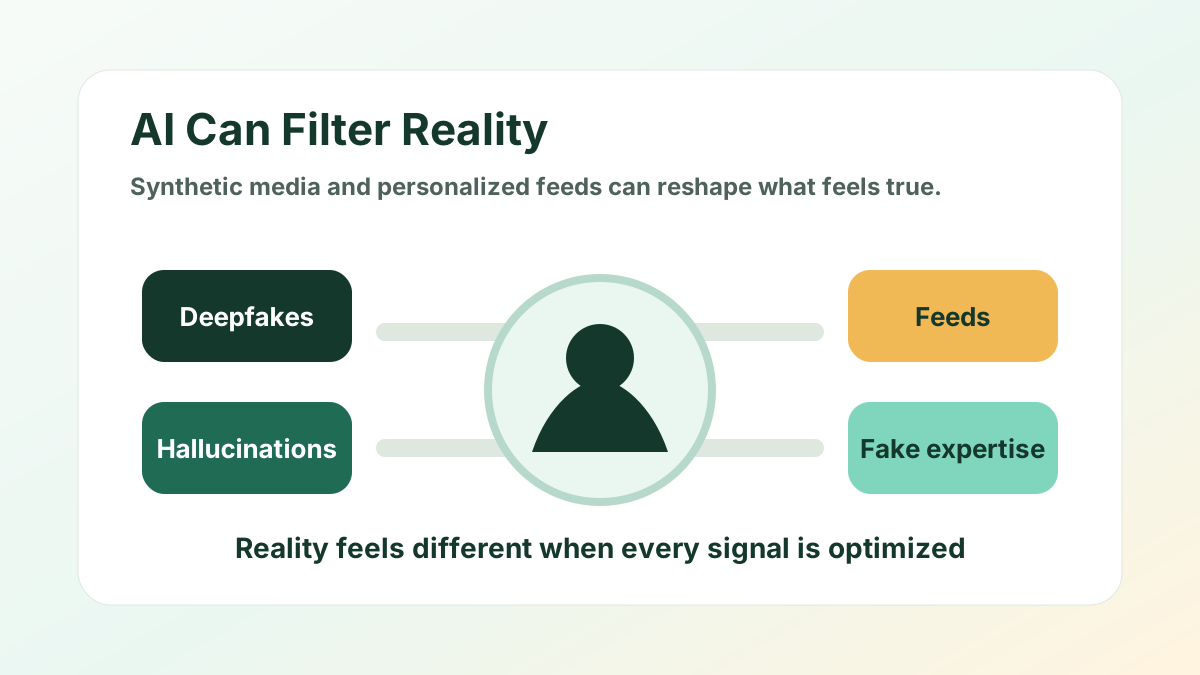
Synthetic content can look like direct evidence
For a long time, many people treated images, video, and audio as stronger evidence than text. A photograph did not prove everything, but it felt closer to reality than a rumor. Generative AI weakens that shortcut. A realistic image can show an event that never happened. A voice clone can make someone appear to say words they never said. A fake screenshot can circulate faster than the correction.
This does not mean you should distrust every image or video. It means visual confidence is no longer enough. The question shifts from "does this look real?" to "where did this come from, who published it, what independent evidence supports it, and has it been altered?" That extra step is tiring, which is exactly why unchecked synthetic media can be so powerful.
Hallucinated information can sound authoritative
AI systems can produce confident answers even when the answer is incomplete, distorted, or wrong. This is often called hallucination, but the ordinary user experience is simpler: the response sounds fluent, specific, and helpful. It may include names, dates, explanations, and references. If you are tired or unfamiliar with the topic, fluency can be mistaken for reliability.
The risk grows when hallucinated answers become part of your memory. You may later remember the claim without remembering that it came from an unverified AI response. Over time, a collection of plausible but weakly sourced claims can reshape your understanding of a subject. You do not become irrational all at once. You simply build on facts that were never checked.
Personalization can narrow your reality
Unchecked AI development also affects reality through personalization. Recommendation systems can learn which topics, tones, fears, and conflicts keep your attention. The result may feel like a world that naturally confirms your concerns. You may see more examples of a problem, more arguments from one side, or more content designed to trigger certainty rather than reflection.
This can create a private reality tunnel. Two people can live in the same city, search the same topic, and come away with very different impressions of what is common, urgent, or true. The problem is not only misinformation. It is proportion. A feed can make rare events feel constant, fringe views feel mainstream, or complex issues feel simple.
AI summaries can hide the original source
Summaries are useful, but they can also detach claims from their evidence. If an AI tool summarizes a report, legal update, medical study, or news story, you may accept the summary without opening the source. That saves time, but it also removes context. You may miss caveats, uncertainty, disagreement, or the difference between what a source says and what the summary implies.
A good summary should function like a map, not a replacement for the territory. If the decision matters, you still need to inspect the original. This is especially important for academic, legal, medical, financial, and political topics. Your understanding of reality becomes weaker when you only consume compressed interpretations and never return to primary evidence.
Fake expertise can become easier to manufacture
AI can help people produce professional-looking articles, bios, citations, charts, and commentary at scale. That makes it easier to create the appearance of expertise without the substance. A website may look polished. A profile may sound credible. A report may include technical vocabulary. None of that proves the author understands the subject or that the evidence is sound.
This matters because humans use style as a shortcut for trust. Clean formatting, confident tone, and precise language can make weak claims feel strong. As AI raises the baseline quality of presentation, readers need better trust signals: transparent authorship, verifiable sources, clear methods, correction history, and independent confirmation.
The line between memory and suggestion can blur
AI assistants can shape how you remember your own work. If a tool rewrites your message, summarizes your notes, or suggests what you "probably meant," it may gradually influence your self-understanding. That is not always bad. A good editor can help you clarify your thinking. But unchecked AI can also smooth away hesitation, complexity, and personal voice until the final version feels more certain than you actually were.
This is a subtle reality problem. It is not only about fake news or deepfakes. It is about whether your own ideas remain anchored in your judgment. If you accept too many generated framings without reflection, you may start outsourcing not just wording but interpretation.
Speed can defeat verification
AI makes production faster. More posts, comments, summaries, images, emails, and reports can be generated in less time. Verification does not scale as easily. A false claim can be created in seconds and take hours to debunk. A fake document can spread before anyone checks metadata or sources. A convincing explanation can be accepted before a specialist sees it.
This imbalance encourages belief by repetition. If you see similar claims everywhere, they may feel true even if they all trace back to the same weak source or automated campaign. Repetition is not evidence, but the human mind often treats it as familiarity, and familiarity can feel like truth.
Reality becomes harder to share
A shared understanding of reality depends on common reference points. People do not need to agree on every interpretation, but they need some agreement about what happened, what was said, what evidence exists, and what remains uncertain. Unchecked AI development can weaken those reference points by flooding the environment with plausible alternatives.
When every image might be fake, every quote might be fabricated, and every source might be automated, some people become overly credulous while others become overly cynical. Both reactions are risky. Believing everything makes you manipulable. Believing nothing makes public reasoning impossible. The healthier response is selective trust grounded in evidence.
How to protect your understanding of reality
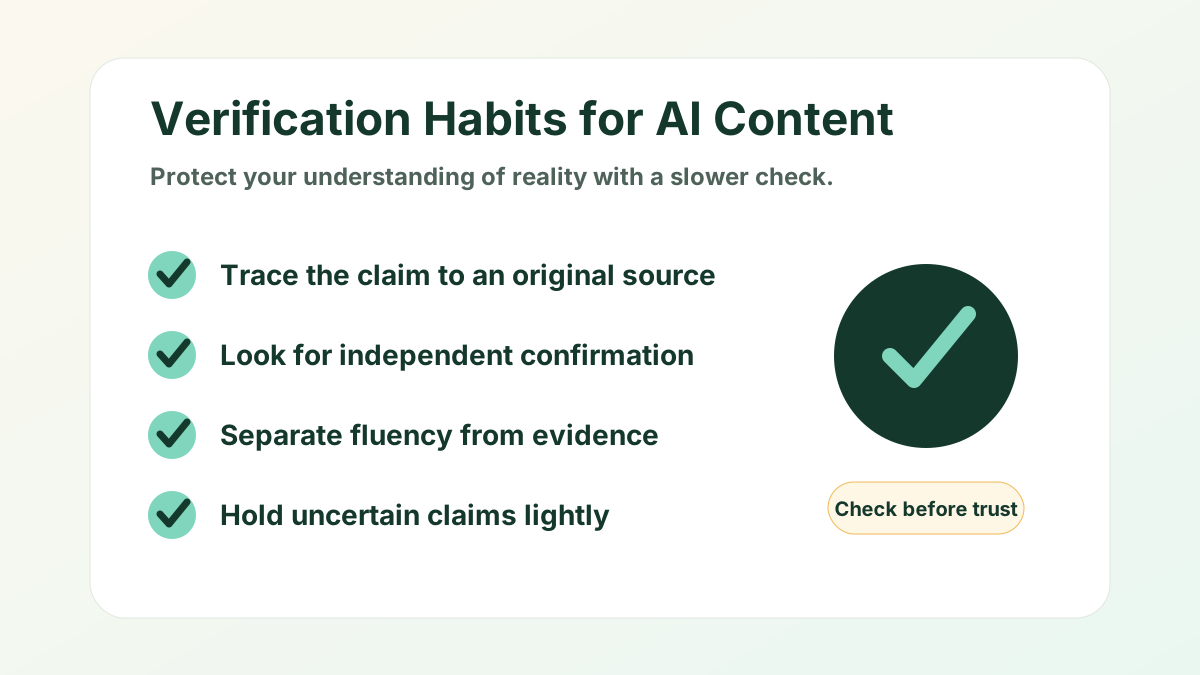
The first defense is source awareness. Ask where a claim came from, whether the source has a reason to know, and whether other credible sources confirm it. The second is friction. Pause before sharing emotionally intense content. The third is reverse checking. Look for the original document, full video, primary study, official statement, or direct data when the topic matters.
The fourth defense is humility. If you cannot verify a claim, hold it lightly. You do not need to decide immediately. The fifth is tool awareness. AI can help you examine text, but it should not become the only authority you consult. Use AI as one layer in a broader verification process, not as a replacement for judgment.
Where AI writing checks fit in
Writing tools can help when your goal is clarity. Uncheck AI can help review AI-like phrasing, reduce generic language, and make a draft easier to read. That can be useful for emails, essays, blog posts, and professional communication. But language quality is not the same as truth. A smoother sentence can still be false. A natural-sounding paragraph can still cite weak evidence.
The best workflow separates style review from fact review. First, check whether the claims are true. Then check whether the writing is clear. If you reverse that order, a polished draft may become harder to question. This is one of the quiet ways unchecked AI output can affect your understanding of reality: it makes unsupported claims feel finished.
Questions to ask when AI shapes what you believe
- What is the original source for this claim?
- Would I believe this if it were written less confidently?
- Does this content show evidence, or only interpretation?
- Can I find independent confirmation from a trusted source?
- Is this feed showing me reality, or a personalized slice of it?
- What would change my mind about this?
FAQ
Can AI make me believe things that are not true?
Yes, especially when AI-generated content is fluent, repeated, personalized, or presented without clear source context. The risk is higher when you do not verify claims before accepting them.
Does unchecked AI development mean AI is always harmful?
No. AI can be helpful when it is used with verification, transparency, and human judgment. The problem is unchecked deployment and unchecked reliance, not every use of AI.
Why does AI content feel so convincing?
AI can imitate the style of expertise: confident tone, organized structure, precise language, and familiar examples. Those signals can feel trustworthy even when the underlying claim is weak.
How can I tell whether AI-generated information is reliable?
Check the source, compare independent references, inspect primary evidence, and be cautious with claims that lack citations or overstate certainty. Reliability comes from evidence, not fluency.
What is the healthiest attitude toward AI-generated content?
Use calibrated trust. Do not panic, and do not blindly accept. Treat AI output as a starting point that may need verification, context, and human judgment.
Final check before you trust or publish
Unchecked AI development can undermine your understanding of reality by weakening the connection between evidence and belief. The answer is not to reject every AI tool. The answer is to rebuild verification habits around a world where convincing content is cheap to produce.
You can use Uncheck AI to make AI-assisted writing clearer and easier to review, but truth still depends on source checking, context, and judgment. For higher-stakes drafts, an additional AI checker can help you inspect the text before you share it.